Database Sharding! Designing Data-Intensive Applications Chapter 6

Tony Duong
Mar 19, 2026 ・ 2 min
#ddia#databases#partitioning#sharding#distributed-systems#video
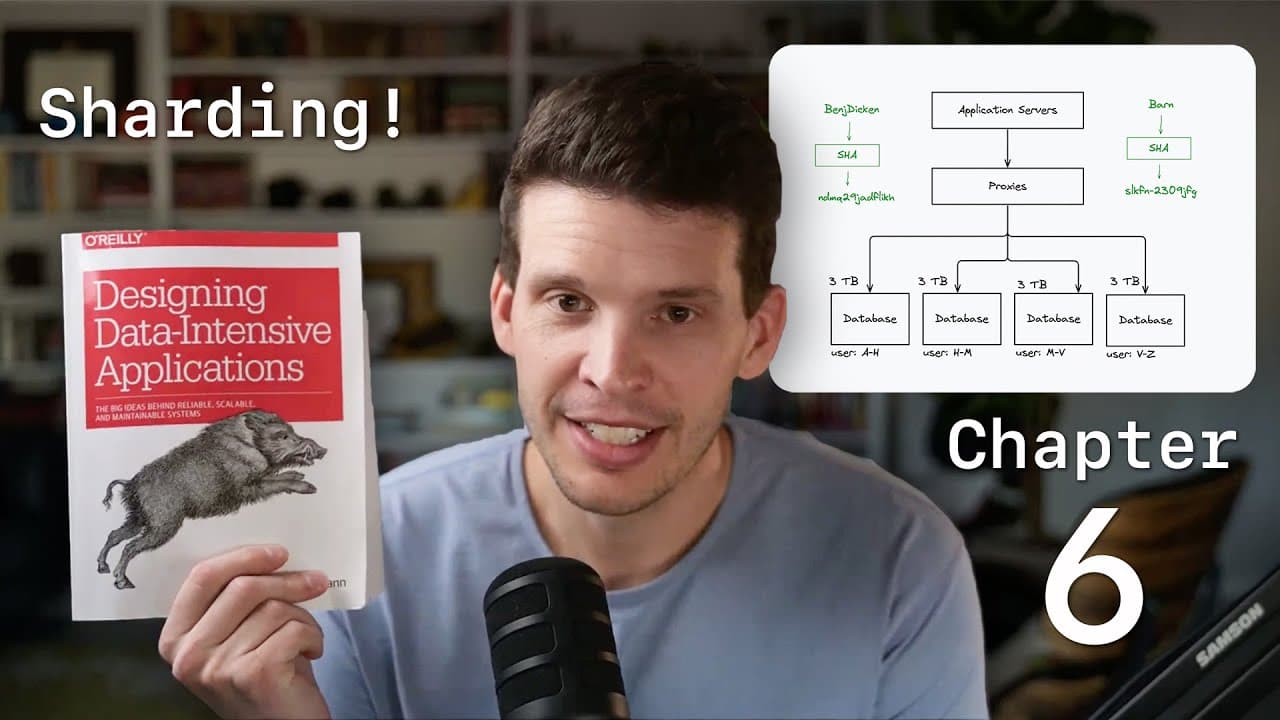
Overview
A video walkthrough of Chapter 6 (Partitioning) from Designing Data-Intensive Applications. The presenter uses diagrams to explain partitioning (often called sharding): splitting data across many machines. The book uses the term "partitioning" for distributing data across nodes; the same idea is commonly called "sharding" in practice.
Key topics covered
- Partitioning vs sharding: Same concept—partitioning can mean splitting tables on one disk or distributing data across machines; here it's the latter.
- Partitioning strategies: Key-range partitioning (e.g. A–M, N–Z) vs hash-based partitioning; trade-offs between range queries and even load.
- Secondary indexes: Local (scatter-gather) vs global indexes when data is partitioned.
- Rebalancing: Moving partitions when adding or removing nodes; fixed partitions, dynamic partitioning, proportional partitioning.
- Request routing: How clients find the right node for a key (routing tier, gossip, or metadata on the client).
Key takeaways
- Partitioning (sharding) scales write throughput and storage beyond a single machine; it's used together with replication.
- Hash partitioning avoids hot spots but loses efficient range scans; key-range partitioning is the opposite.
- Secondary indexes with partitioning require either scatter-gather (local index) or more complex writes (global index).
- Rebalancing should minimize data movement and avoid single points of failure.