Designing Data-Intensive Applications: Chapter 3

Tony Duong
Mar 13, 2026 ・ 5 min
Overview
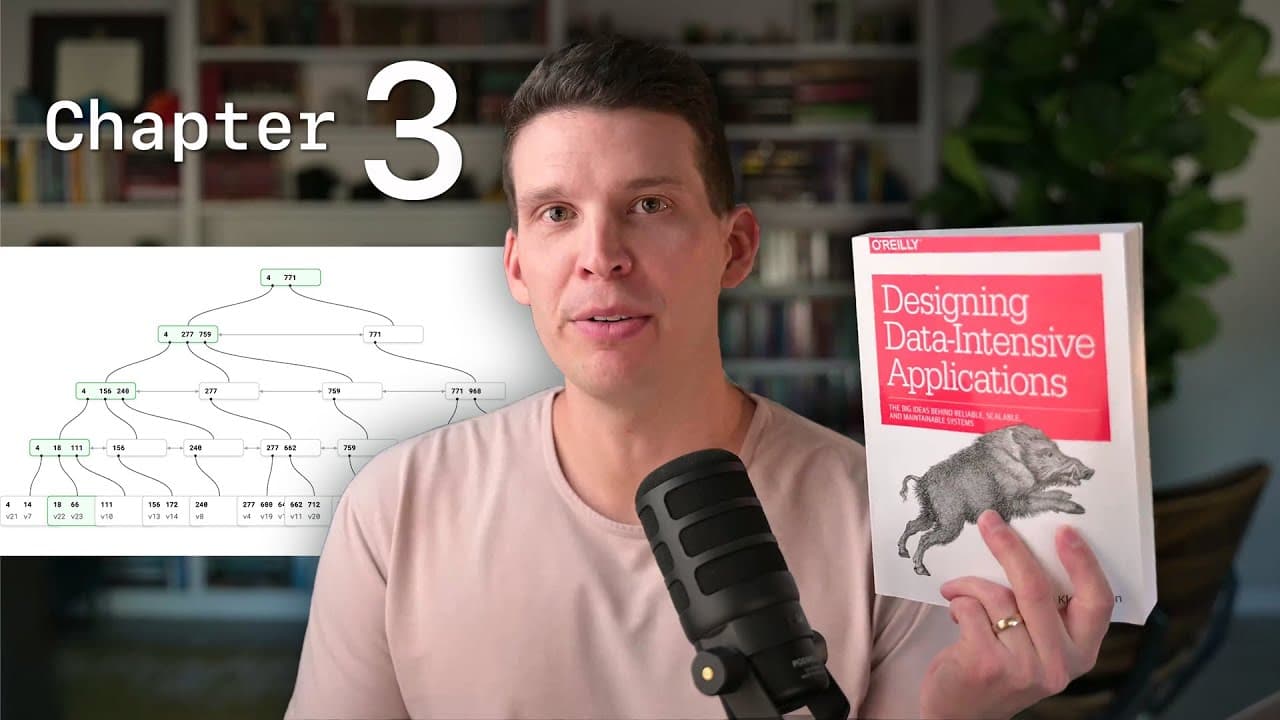
A livestream walkthrough of DDIA Chapter 3: Storage and Retrieval. The presenter draws diagrams and explains how databases store and retrieve data at the disk level, focusing on two main themes: OLTP vs OLAP databases and how their different access patterns lead to fundamentally different storage layouts.
OLTP vs OLAP: Two Different Worlds
OLTP (Online Transaction Processing):
- Powers web apps — MySQL, Postgres, SQLite, Oracle
- Short, fast transactions (sub-millisecond)
- Mostly reads (80-90%), fewer writes (10-20%)
- Queries fetch small numbers of rows by key (e.g.,
SELECT * FROM users WHERE id = 2) - Databases: MySQL, Postgres, SQLite
OLAP (Online Analytical Processing):
- Powers business intelligence and analytics
- Scans over large amounts of data ("all products sold this year", "user trends over 6 months")
- Queries take longer, and that's fine — not user-facing
- Data is extracted from OLTP databases via ETL (Extract–Transform–Load) into a dedicated data warehouse
Why separate them? Running heavy analytical scans on an OLTP database would cause cache thrashing and slow down the application for end users.
Row-Oriented Storage (OLTP)
In OLTP databases, data is stored by row on disk:
[ID:1, Ben, ben@hi.com, 1234 Fifth St] [ID:2, Zed, zed@mail.com, 5678 Oak Ave] [ID:3, Ally, ...]
This layout is optimal when queries typically:
- Select a single row or a small set of rows
- Need all or most columns from those rows
- Access data by primary key
Since all columns for a row are physically adjacent on disk, a single page read gives you everything you need for that row.
B-Trees: The OLTP Index
B-trees are the dominant indexing structure in OLTP databases:
- Nodes are sized to match disk page size (typically 4 KB)
- Each node contains multiple key-value pairs — efficient for disk I/O since reads happen in page-sized chunks
- Search traverses from root to leaf, reading one page per level
MySQL vs Postgres implementation:
- MySQL (InnoDB): stores actual row data in the B-tree leaf nodes (clustered index)
- Postgres: stores row data in a "heap file" (a big array of pages), and B-tree indexes contain pointers into that heap file
- Both support secondary B-tree indexes
Trade-offs: B-trees leave empty space in nodes for future insertions, and random writes require traversing parent nodes. Great for general-purpose workloads, but not optimal for high-volume sequential writes.
Column-Oriented Storage (OLAP)
In OLAP databases, data is stored by column:
Names:     [Ben, Zed, Ally, ...]
Emails:    [ben@hi.com, zed@mail.com, ally@x.com, ...]
Addresses: [1234 Fifth St, 5678 Oak Ave, ...]
Why this matters for analytics:
- Analytical queries typically scan many rows but only need a few columns (e.g.,
SELECT AVG(price) FROM sales WHERE date > '2025-01-01') - With row storage, you'd load every column for every row — wasted I/O
- With column storage, you only read the columns the query actually needs
Column ordering: rows must be in the same order across all column files so you can reconstruct which values belong together.
Column Compression
Columns are highly compressible because they contain repetitive data:
- Thousands of users share the same name
- Emails share common substrings (
@gmail.comappears millions of times) - Dates repeat frequently (many events on the same day)
Techniques include bitmap encoding and run-length encoding. Compression reduces storage size and speeds up queries by reducing I/O — especially important since OLAP databases can reach petabytes of historical data.
LSM Trees: Optimized for Writes
LSM trees (Log-Structured Merge Trees) are designed for workloads with high write throughput:
- Click event streams, log ingestion, metrics collection
- Continuous, high-pace sequential data
How they differ from B-trees:
- B-trees update pages in place and leave empty space for future writes — good for read-heavy workloads
- LSM trees buffer writes in memory and flush sorted segments to disk, then merge in the background — much better write throughput
Used by: Cassandra, ClickHouse, RocksDB, LevelDB
Trade-off: B-trees give more predictable read latency; LSM trees give higher write throughput but reads may need to check multiple structures.
The Simplest Database
The chapter starts with a fun thought experiment: you can build a functional key-value database in 6 lines of bash — append key-value pairs to a file on write, grep through it on read. It works, but illustrates why real databases are millions of lines of code: this approach has O(n) reads, no transaction support, no concurrency handling, and no durability guarantees.
Key Takeaways
- OLTP and OLAP databases exist because their access patterns are fundamentally different — don't run analytics on your production database
- Row storage groups all columns for a row together — optimal for fetching individual records
- Column storage groups all values for a column together — optimal for scanning and aggregating large datasets
- B-trees are the workhorse of OLTP indexing, sized to match disk pages for efficient I/O
- LSM trees trade read latency for write throughput, making them ideal for high-ingestion workloads
- Column compression (bitmap encoding, run-length encoding) is critical for OLAP databases that can reach petabyte scale