Designing Data-Intensive Applications: Chapter 5

Tony Duong
Mar 16, 2026 ・ 2 min
#ddia#databases#replication#distributed-systems#video
Overview
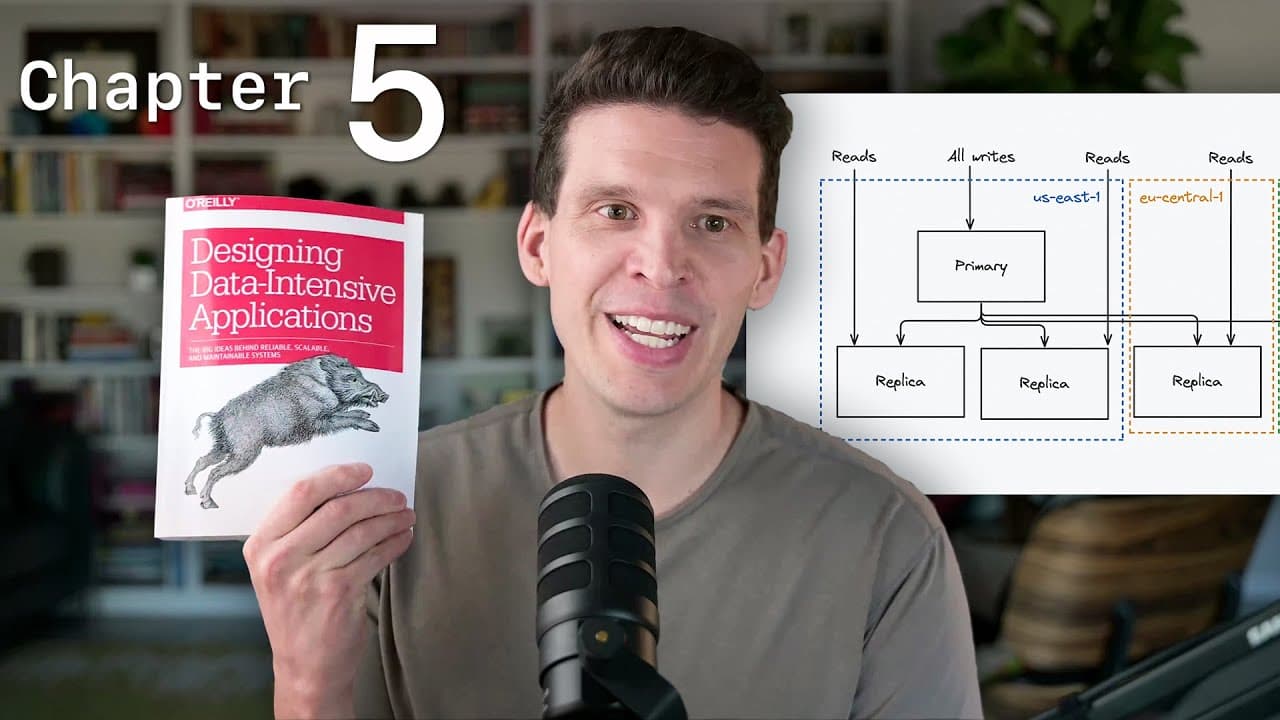
A live stream that walks through Chapter 5 (Replication) of Designing Data-Intensive Applications. The host uses diagrams (e.g. in Excalidraw) to explain single-leader replication, why you use it, and how it fits into cloud deployments. The book is recommended as a high-level reference for data systems; you can jump to a chapter (e.g. replication) when you need it.
Single-Leader (Primary–Replica) Replication
- Setup: One primary node accepts all writes; one or more replicas (followers) receive a stream of changes and stay in sync. Terminology varies (primary/replica, master/slave, etc.).
- Traffic flow: All writes go to the primary. Replicas are read-only; read traffic can be sent to them from app servers. This matches many workloads where the majority of queries are reads (e.g. loading a profile, a timeline).
- Scaling reads: As traffic grows, you can add more replicas without taking down the primary or disrupting existing replica traffic. This scales read capacity well until you need to distribute data (sharding/partitioning).
Why Replicate?
- Read capacity: Spread read load across replicas so the primary isn’t the bottleneck for reads.
- Availability (often more important): In the cloud, instances are ephemeral—they can fail, be decommissioned, or lose network connectivity. A single node going away for even 60 seconds can be unacceptable. With a primary and at least one replica (two is better), you can fail over if the primary is lost.
- Placement: Primary and replicas are typically spread across availability zones (AZs) within a region (e.g. US East 1, US West 1). Each AZ is in the same region but in a separate building with some geographic separation; providers try to make it unlikely that multiple AZs fail at once (different power, network links, etc.). Spreading nodes across AZs improves fault tolerance.
Key Takeaways
- Single-leader replication is the standard pattern before you need sharding/partitioning; it’s what many managed DBs (e.g. PlanetScale) offer by default (e.g. primary + two replicas).
- Replication gives you both read scaling and high availability; the latter is often the more critical reason in production.
- Understanding regions and availability zones helps when placing your primary and replicas in the cloud.