Kafka vs RabbitMQ

Tony Duong
Jun 11, 2026 ・ 6 min
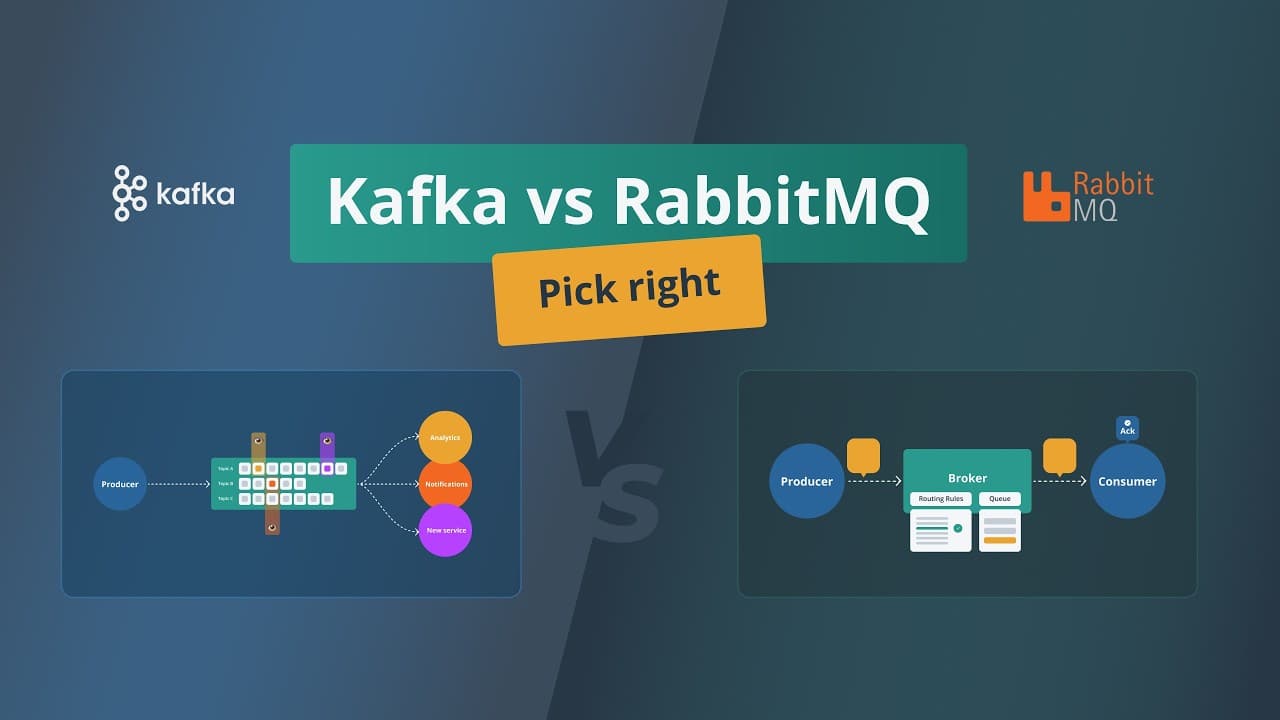
Kafka and RabbitMQ aren't interchangeable — picking the wrong one can mean significant rework later. But they exist to solve the same fundamental problem: when one service calls another directly (order service → inventory service over HTTP), the caller gets stuck waiting, times out, or drops requests the moment the callee is slow or down. A message queue adds a buffer between services: the producer drops a message and returns immediately, and the consumer processes it whenever it's ready. During a flash-sale spike, the queue absorbs the load and lets downstream services work at their own pace.
Both give you this decoupling — producers, consumers, a broker in the middle. But how they work under the hood is fundamentally different, and that's what should drive the choice.
RabbitMQ: a smart broker with simple consumers
RabbitMQ is a traditional message broker with an intuitive queue mental model:
- A producer sends a message to the broker.
- The broker applies routing rules you configured to decide which queue it belongs to.
- A consumer pulls messages off the queue, processes them, and sends an acknowledgement.
- On ack, RabbitMQ deletes the message. Failed deliveries are retried, and after repeated failures the message is moved to a dead-letter queue automatically.
The broker does the heavy lifting — routing, tracking deliveries, retries, dead-lettering — while the consumer just subscribes, processes, and acks. This maps cleanly onto task-oriented workloads: sending emails, processing payments, resizing images. A unit of work goes in, something does it, the message disappears. (In Kafka you'd build dead-letter handling yourself.)
Kafka: a simple broker with smart consumers
Kafka is essentially a distributed append-only log. A producer appends a message to a topic, and it doesn't disappear when read — it stays in the log for hours, days, weeks, or indefinitely depending on retention.
- Consumers track their own position, called an offset. Read message 500 → remember you're at 500. Crash and restart → look up where you left off and resume.
- Need to reprocess an hour ago? Just rewind the offset.
- Messages are durable and replayable, so multiple consumer groups read the same stream independently — analytics and real-time notifications consume the same events, and a service that comes online six months later can read the entire history from day one.
So: RabbitMQ is a message broker — messages flow through it; Kafka is a log — messages live in it. In RabbitMQ a consumed message is gone; in Kafka messages persist and any number of consumers can read them from any point in history. This one difference drives almost every other trade-off — which is why many teams use both: Kafka as the durable event stream, RabbitMQ as the task queue processing the work those events trigger.
The technical trade-offs
Ordering
- RabbitMQ queues are strictly ordered — a single consumer gets perfect ordering. Add multiple consumers for throughput and you trade away that ordering.
- Kafka splits each topic into partitions; order is guaranteed only within a partition. A partition key routes related messages together (all of customer 12345's orders → same partition, processed in sequence) — so you get per-entity ordering with parallelism, but no global order.
- Trade-off: RabbitMQ = global ordering with one consumer; Kafka = per-entity ordering with parallelism.
Throughput & latency
- RabbitMQ: ~4,000–10,000 msgs/sec, ~1–5 ms latency at low volume. The broker pushes messages but does a lot of per-message work (delivery state, acks, routing), so throughput drops as that overhead adds up.
- Kafka: 1,000,000+ msgs/sec (~100×), but higher baseline latency (~5–50 ms) because consumers pull in batches. The broker just appends to a sequential log, so latency stays consistent even as volume grows.
Delivery guarantees
When a consumer fails to process a message, you either lose it or redeliver it (risking duplicates):
- At-most-once: broker sends once, no retry — fast, but messages can be lost forever.
- At-least-once: broker retries until acked — no data loss, but consumers may see a message twice. Both systems support this; it's the industry-standard default.
- Exactly-once: Kafka supports it, but it's much narrower than it sounds — only when input and output are Kafka topics in the same cluster under Kafka transactions. The moment you write to a database, call an external API, or cross clusters, you're back to at-least-once. Don't pick Kafka just for "exactly-once" — in practice you still need idempotent consumers.
Operational complexity
- RabbitMQ is simpler: a single binary, straightforward clustering, built-in management UI — approachable for a small team running a few queues.
- Kafka is harder: historically needed Zookeeper (newer versions use Raft instead), plus partition rebalancing, broker failures, topic configs, and consumer-group coordination. Managed services (Confluent Cloud, Amazon MSK, Azure Event Hubs) absorb most of this — strongly consider one unless you already have infra expertise.
When to use which
Reach for RabbitMQ when you need task queues / background jobs (emails, payments, image resizing — work goes in, gets done, disappears), smart content-based routing, low latency at moderate scale, and simple operations. Real-world: Instagram processes photo uploads (resizing/filtering) via RabbitMQ workers; Reddit uses it for comment threads and karma.
Reach for Kafka when you need multiple systems reading the same events independently (analytics, fraud detection, billing, audit logging), replay of historical data, massive scale (millions of events/sec with consistent latency), or a durable permanent event history. Real-world: Netflix processes petabytes/day for recommendations and billing; Uber uses it for real-time pricing and fraud detection; LinkedIn invented Kafka and powers its feed and messaging with it.
Key takeaways
- Smart broker + simple consumers (RabbitMQ) vs simple broker + smart consumers (Kafka) — this is the root distinction.
- Queue vs log: RabbitMQ deletes on ack; Kafka retains and lets any consumer replay by offset.
- Ordering: RabbitMQ global (single consumer) vs Kafka per-partition (parallel) — choose your partition key deliberately.
- Throughput/latency: RabbitMQ ~4k–10k msgs/sec at 1–5 ms; Kafka 1M+/sec at 5–50 ms.
- Don't chase exactly-once — it's Kafka-cluster-internal only; build idempotent consumers regardless.
- If your use case is a constrained task queue, pick RabbitMQ for simplicity; for durable, replayable, high-scale event streams, lean Kafka (likely managed). Or use both.