Distributed Transactions Explained: 2 Phase Commit vs Saga Pattern

Tony Duong
Jun 2, 2026 ・ 6 min
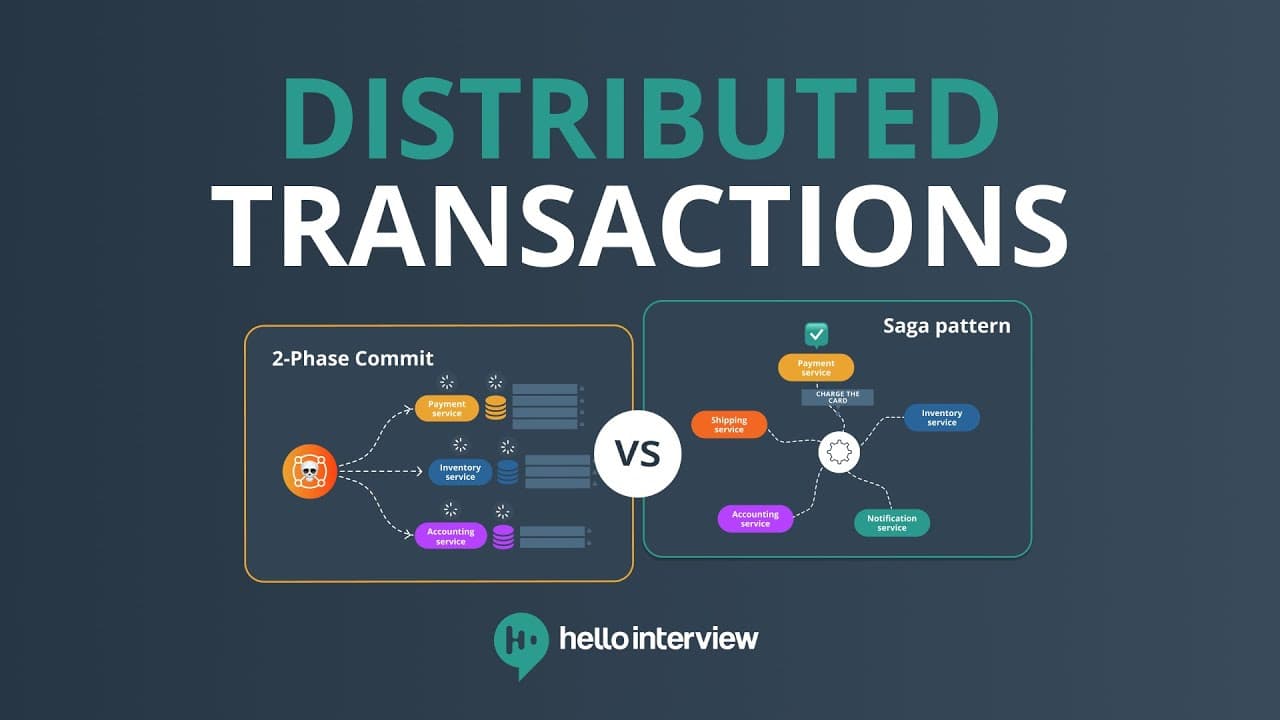
Notes from Hello Interview on distributed transactions — what changes when one database becomes many, why two-phase commit (2PC) rarely works across services, and why the industry uses Saga instead.
When transactions were easy
Early on, a single database handles everything. Place an order: charge card, reserve inventory, record ledger entry — all in one transaction. If any step fails, the DB rolls back automatically.
ACID guarantees that matter here:
- Atomicity — all three writes succeed together, or none do
- Isolation — no other query sees half-finished state while the transaction runs
What changes when you scale out
Traffic and data grow. You shard the database or split into microservices — each service owns its own DB on its own machine.
The payment flow that was one transaction is now three separate operations on three separate databases:
- Charge card (payment DB)
- Reserve inventory (inventory DB)
- Record ledger entry (accounting DB)
You can't wrap a transaction across independent databases. If the card charge commits but inventory reservation fails (out of stock), there's no DB-level rollback — the charge is already committed elsewhere.
This is a distributed transaction: one logical operation spanning multiple independent databases/services where all steps must succeed together or be cleaned up.
Two-phase commit (2PC)
Classic academic solution. Introduce a coordinator that ensures all participants agree before anything becomes permanent.
Phase 1 — Prepare
Coordinator asks every participant: "Can you commit?" Each DB does the work, durably records changes, locks affected rows, and votes yes or no.
- Any no → coordinator tells everyone to abort and release locks
- All yes → move to phase 2
Phase 2 — Commit
Coordinator sends commit to everyone. Participants make changes permanent and release locks.
Benefit: strong consistency — same guarantee as a single DB. No partial state visible.
Why 2PC fails in production
2PC is a blocking protocol — dangerous in distributed systems because you depend on multiple machines staying healthy simultaneously.
Coordinator crash scenario: coordinator collects all yes votes, then crashes before sending commit. Participants sit with locks held, unable to commit or abort. Every transaction touching those rows is blocked.
Other problems:
- Slowest participant wins — one slow service holds locks for everyone
- Network partitions — coordinator can't tell if a message got through; no safe default
Industry reality: almost nobody uses 2PC across independent services. Pat Helland's "Life Beyond Distributed Transactions" argues distributed transactions across autonomous services don't work at internet scale.
2PC exists in production inside distributed databases (Google Spanner, YugabyteDB) where coordinator and participants are tightly coupled — the DB handles complexity internally. Across services with different deployment schedules and failure modes, it falls apart.
Saga pattern
What Uber, Netflix, Amazon, and DoorDash use in production.
Different assumption: you don't need all-or-nothing atomicity across services. You need to eventually reach a consistent state when things go wrong.
Instead of one big distributed transaction with cross-service locks:
- Break work into a chain of independent local transactions
- Each service commits to its own DB on its own terms
- When a later step fails, run compensating actions (business-level undos): refund instead of rollback, cancellation instead of abort
Trade-off: eventual consistency instead of strong consistency. The system may be temporarily inconsistent while compensations run (customer briefly sees a charge before refund). But nothing is blocked — other transactions keep flowing.
Choreography vs orchestration
Choreography (decentralized)
Publish/subscribe: each service broadcasts an event when done; interested services react.
- Card service charges → publishes
CardCharged - Inventory service listens → reserves stock → publishes
InventoryReserved - Ledger service records entry
- On failure, failing service publishes failure event; upstream services run compensations
Works for 2–3 step simple flows. At 5–6 services, tracing state becomes painful — digging through logs across a dozen services to answer "where did it fail? did the refund go through?"
Orchestration (centralized)
Dedicated orchestrator controls the flow step by step: charge card → wait → reserve stock → wait. On failure, orchestrator knows exactly what failed and runs compensations in the right order.
Tools: Temporal (from Uber Cadence engineer), AWS Step Functions.
Key difference from 2PC coordinator: orchestrator is durable. On crash, it reads state from its DB and resumes — no dangling locks, no blocked transactions during recovery.
Most teams at serious scale use orchestration.
Compensating actions — the hard part
"Just undo the previous step" sounds clean but gets messy:
- Refund is visible to the customer (charge notification, then refund notification) — correct but not invisible like a DB rollback
- Some actions can't be undone: sent email, fired webhook to third party
- Each saga step needs a well-defined compensation; some are inherently imperfect
- Compensations can fail too — refund API down → need retry logic
- Retried refunds must be idempotent (run once or ten times, same result)
Dual write problem and transactional outbox
After charging the card, the service must:
- Save result to its DB
- Publish an event so the next step proceeds
These are two separate writes to two systems:
- DB succeeds, publish fails → saga stalls
- Publish succeeds, DB fails → downstream reacts to something that didn't happen
Fix: transactional outbox
- Write data and outgoing event to the same DB in one local transaction (event goes in an
outboxtable) - Either both commit or neither do
- Background process (CDC tailing transaction logs, or polling outbox table) publishes events to the message broker
Decision framework
First: do you need a distributed transaction at all?
If data that transacts together can live in the same database, do that. Move inventory and ledger tables into the payments DB if they always update together. Local ACID is simpler, faster, and more reliable than any distributed alternative.
If you genuinely can't avoid distributing
Use a Saga — industry default, not really debated.
| Situation | Choice |
|---|---|
| 3–4 steps, independent services, no need for centralized visibility | Choreography (e.g. order-placed → email notification) |
| Complex flows, branching, need to see where transactions are stuck, tricky compensation logic | Orchestration (Temporal, Step Functions) |
| Eventual consistency truly unacceptable | Consider single distributed DB (Spanner, YugabyteDB) with internal strong consistency — not DIY 2PC across services |
Production pattern at scale
Saga with orchestration + idempotent operations at every step + transactional outbox for reliable events.
Accept eventual consistency deliberately — that's the trade-off Uber, Netflix, and Amazon run in production today.
Key takeaways
- Single-DB ACID breaks when services own separate databases — partial failures become routine, not edge cases
- 2PC gives strong consistency but blocks on coordinator crashes, slow participants, and partitions — avoid across independent services
- Saga uses local commits + compensating actions for eventual consistency without blocking
- Choreography for simple flows; orchestration for complex ones (Temporal, Step Functions)
- Design compensations carefully — they're visible, imperfect, and need idempotent retries
- Use transactional outbox to avoid the dual-write problem
- Best answer when possible: don't distribute the transaction — colocate data in one DB