Don't Build Agents, Build Skills Instead

Tony Duong
Mar 13, 2026 ・ 4 min
Overview
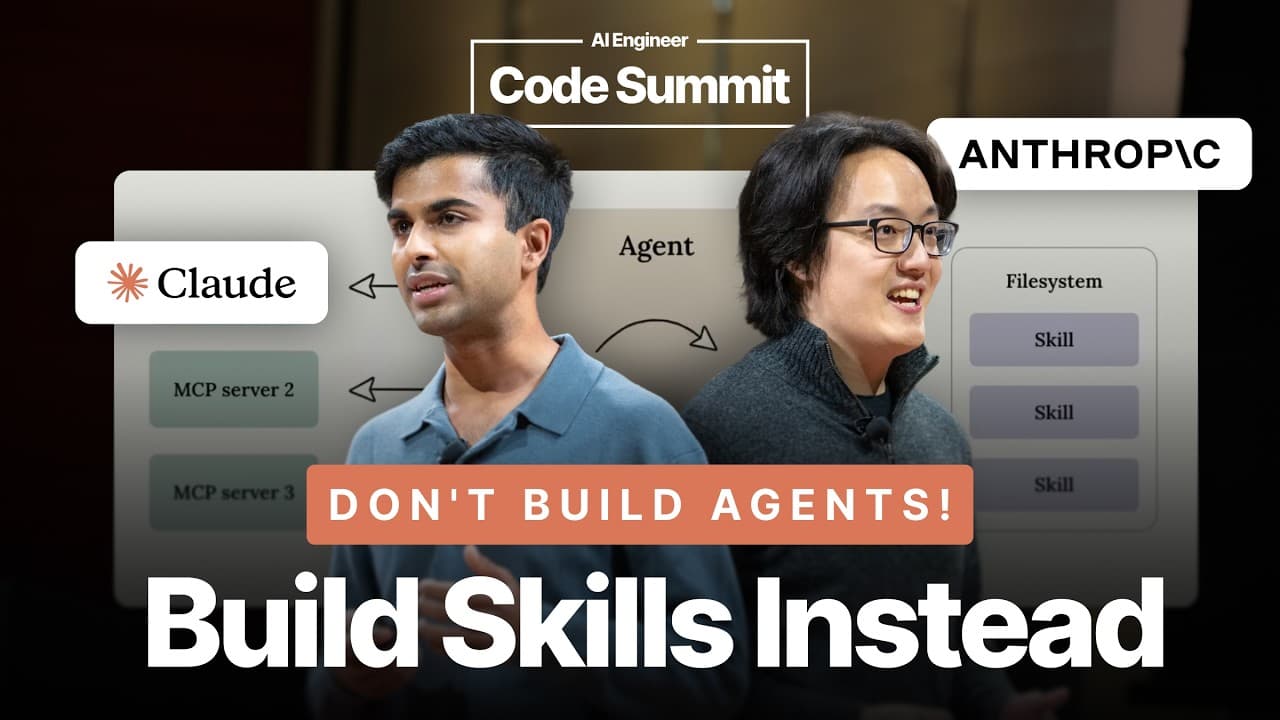
Barry Zhang and Mahesh Murag from Anthropic present agent skills — a new paradigm for extending general-purpose agents like Claude Code. Instead of building separate agents for each domain, they argue we should build skills: organized folders of procedural knowledge that any agent can pick up and use.
The Problem: Intelligence Without Expertise
Agents today are like a 300 IQ genius with no domain experience. They can figure things out from first principles, but you don't want that for your taxes — you want a domain expert who executes consistently.
Current agents:
- Are brilliant but lack expertise
- Can do amazing things with enough guidance, but miss important context upfront
- Can't absorb your expertise well
- Don't learn over time
What Are Skills?
Skills are organized collections of files that package composable procedural knowledge for agents. In practice: they're folders.
This simplicity is deliberate:
- Anyone (human or agent) can create and use them
- They work with existing tools — version in Git, share via Google Drive, zip and send
- They can include scripts as tools alongside instructions
Why Files Over Traditional Tools?
Traditional tools have problems:
- Poorly written instructions, ambiguous behavior
- When the model struggles, it can't modify the tool — it's stuck
- They always live in the context window
Code/files solve these issues:
- Self-documenting
- Modifiable by the agent
- Can live in the file system until needed
Progressive Disclosure
Skills protect the context window through progressive disclosure:
- At runtime, only metadata is shown (skill name/description)
- When needed, the agent reads the SKILL.md with core instructions
- Everything else (scripts, assets, examples) is organized in the folder for on-demand access
This allows fitting hundreds of skills while keeping them composable.
Types of Skills
Foundational Skills
General or domain-specific capabilities the agent didn't have before.
- Document skills (by Anthropic): create/edit professional Office documents
- Scientific research skills (by Cadence): EHR data analysis, bioinformatics libraries
Third-Party Skills
Partners building skills for their own products:
- Browserbase/Stagehand: browser automation and web navigation
- Notion: deep research over your entire workspace
Enterprise Skills
Company and team-specific skills:
- Teaching agents organizational best practices
- Developer productivity teams deploying to thousands of developers
- Encoding code style, internal tooling knowledge, and workflows
The Emerging General Agent Architecture
The architecture is converging on:
- Agent loop — manages internal context and token flow
- Runtime environment — file system + ability to read/write code
- MCP servers — tools and data from the outside world (connectivity)
- Skills library — hundreds/thousands of skills pulled into context on demand (expertise)
MCP provides the connection; skills provide the expertise.
Giving an agent new capabilities in a new domain = equipping it with the right MCP servers + the right skills.
Future Directions
Skills as Software
As skills get more complex (packaging executables, binaries, assets), they need:
- Testing and evaluation — measuring output quality
- Trigger tooling — ensuring skills load at the right time for the right task
- Versioning — tracking behavior changes over time
- Dependencies — skills referring to other skills, MCP servers, or packages
Continuous Learning
Skills are designed as a concrete step towards continuous learning:
- Anything Claude writes down can be used by a future version of itself
- Memory becomes tangible — capturing procedural knowledge for specific tasks
- Claude can acquire, evolve, and drop skills as needed
- Goal: Claude on day 30 is much better than Claude on day 1
Sharing and Distribution
The most exciting vision: a collective, evolving knowledge base curated by people and agents:
- New team members get an agent that already knows the team's practices
- Community-built skills make everyone's agents more capable
- Similar to how community MCP servers benefit all agents
The Computing Analogy
| Computing | AI |
|---|---|
| Processors | Models |
| Operating Systems | Agent runtimes |
| Applications | Skills |
A few companies build processors and OSes, but millions of developers build applications. Skills open up this "application layer" for everyone.
Key Takeaways
- Code is the universal interface — Claude Code is actually a general-purpose agent, not just a coding tool
- Skills = folders — deliberately simple so anyone can create and share them
- Progressive disclosure protects context window while enabling hundreds of skills
- MCP + Skills are complementary — MCP for connectivity, skills for expertise
- Stop rebuilding agents — the agent is universal; customize it with skills instead
- Skills enable continuous learning — agents that get better the more you use them